Novel Wet-TSA Adsorption and Concentration Technology
Principles of Wet-TSA and reasons for its superiority
The Wet-TSA method is based on the opposite idea to the conventional TSA method, which aims to avoid the influence of water vapor as much as possible. It is a method of adsorbing and desorbing CO2 in a constantly wet state, and the temperature change caused by the transition between water and water vapor does not hinder the adsorption and desorption performance, but rather acts to assist it, dramatically improving the adsorption and concentration performance.
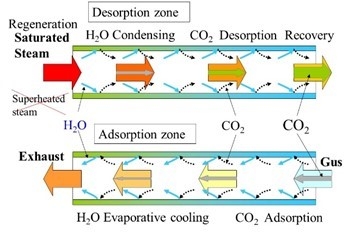
The principle of the Wet-TSA method is that saturated steam is introduced into the adsorbent that has adsorbed gas, and the adsorbed CO2 gas is desorbed using the heat of condensation of the saturated steam. The heat capacity per volume of saturated steam is tens to hundreds of times that of dry air, so gas can be desorbed with a small amount of saturated steam, and the desorbed gas can be concentrated to nearly 100% concentration and extracted.
In the conventional TSA method, air is heated and used as the desorption gas, so air is always mixed in with the desorbed gas, making it impossible to recover a high concentration.
When adsorbing gas with the Wet-TSA method, the water vapor that condenses during desorption does a good job. When the condensed water evaporates as the treated gas passes through, the adsorbent is cooled by the evaporative cooling effect, improving the adsorption performance. At the same time, the heat of adsorption of the gas is also removed by the evaporative cooling effect, so the air temperature of the treated gas hardly rises at all, which is why the Wet-TSA method is able to achieve dramatically high performance.
Principle of wet TSA
Prevention of thermal and oxidative degradation of adsorbents by the wet TSA method.
While there are various CO2 adsorbents, amine-based materials are advantageous for desorption at low temperatures to around 100°C. However, amine-based materials have the drawback of being susceptible to thermal oxidative degradation. Therefore, various research institutions and researchers are working to improve their performance and durability. Furthermore, it seems that some are researching robust adsorption and concentration systems that use vacuum desorption to prevent thermal oxidative degradation, and then extract the CO2 with low-pressure, low-temperature saturated steam at 70-80°C. The Wet-TSA method is entirely operated under atmospheric pressure and incorporates measures to prevent thermal oxidative degradation.
Because it is a Wet-TSA method
① Because desorption is performed using saturated vapor that does not contain oxygen, the adsorbent does not come into contact with oxygen during high-temperature desorption.
② Even if the adsorbent is moved to the adsorption zone at a high temperature after desorption, the surface of the adsorbent is covered with condensed water, and it is quickly cooled by the evaporative cooling effect of the condensed water, so oxidative degradation is avoided.
③ The durability of amine-based adsorbents may be improved by always maintaining a hydrated state
Circulating purge to prevent thermal and oxidative degradation of adsorbents
① In the recovery zone, before the rotor moves to the desorption zone where it reaches its highest temperature, a mixture of desorption CO2 and water vapor is passed through. This prevents oxygen from entering the desorption zone, thus preventing thermal and oxidative degradation.
② As a more advanced technique, a "circulating purge zone" combining CO2 gas purging and air purging can be installed before and after the desorption and recovery zones. This circulating purge exchanges and purges the gas before it moves from the desorption zone to the adsorption zone due to the rotor's rotation with the air before it moves from the adsorption zone to the recovery zone. This is expected to improve the concentration of recovery CO2 and reduce the leakage of desorbed CO2 gas.