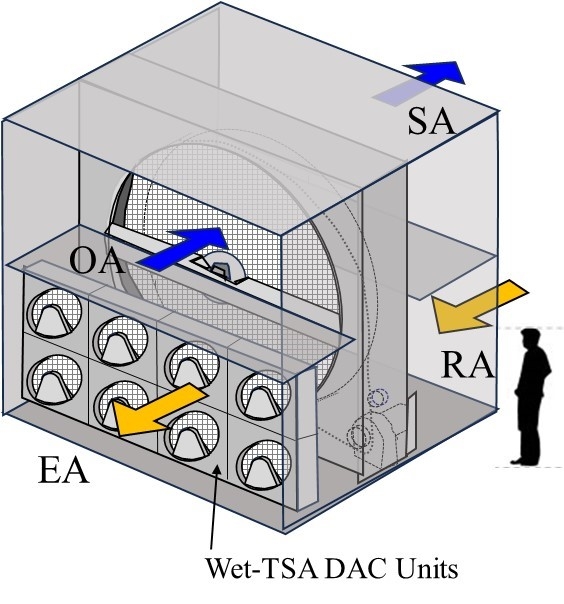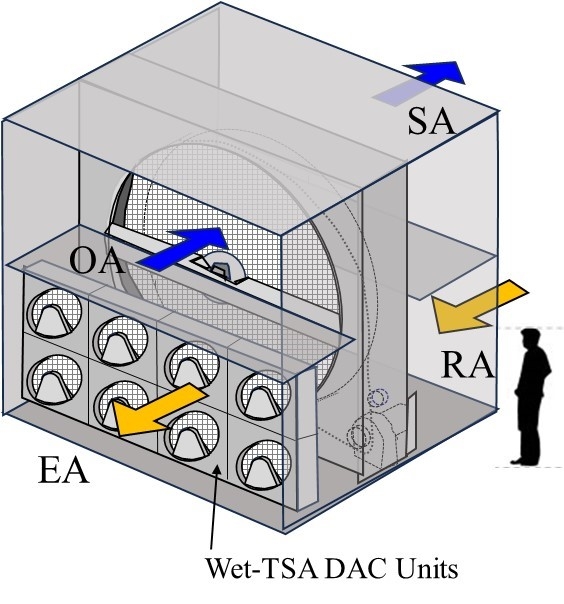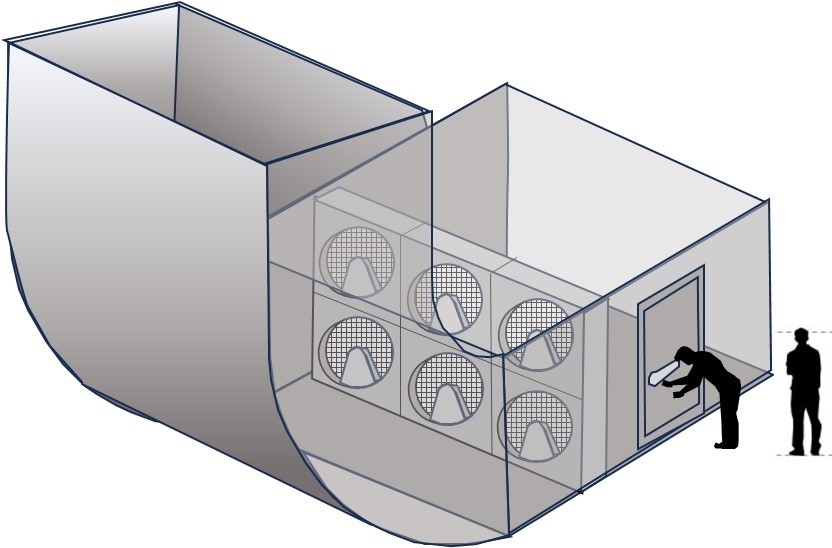
This document explains a patented flow that further enhances the performance of CO2 separation, concentration, and recovery using the Wet-TSA method.
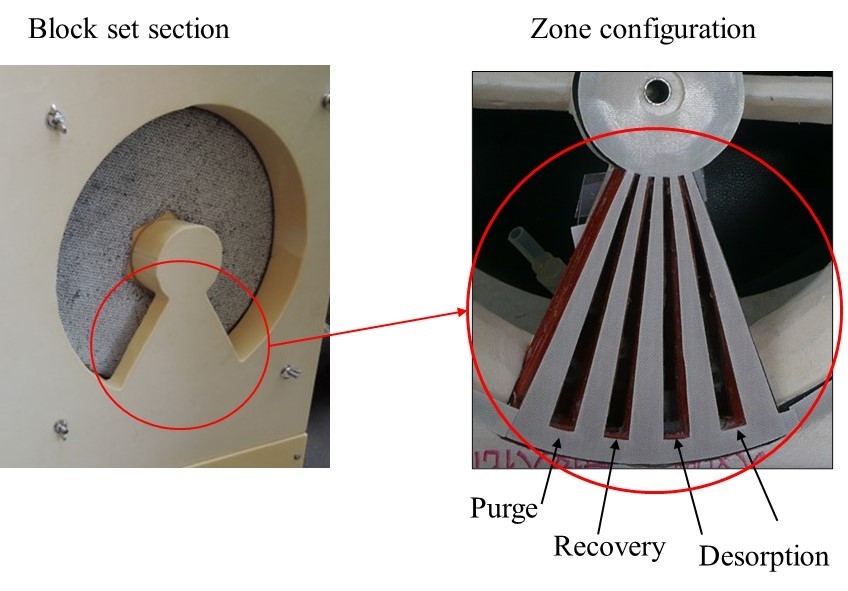
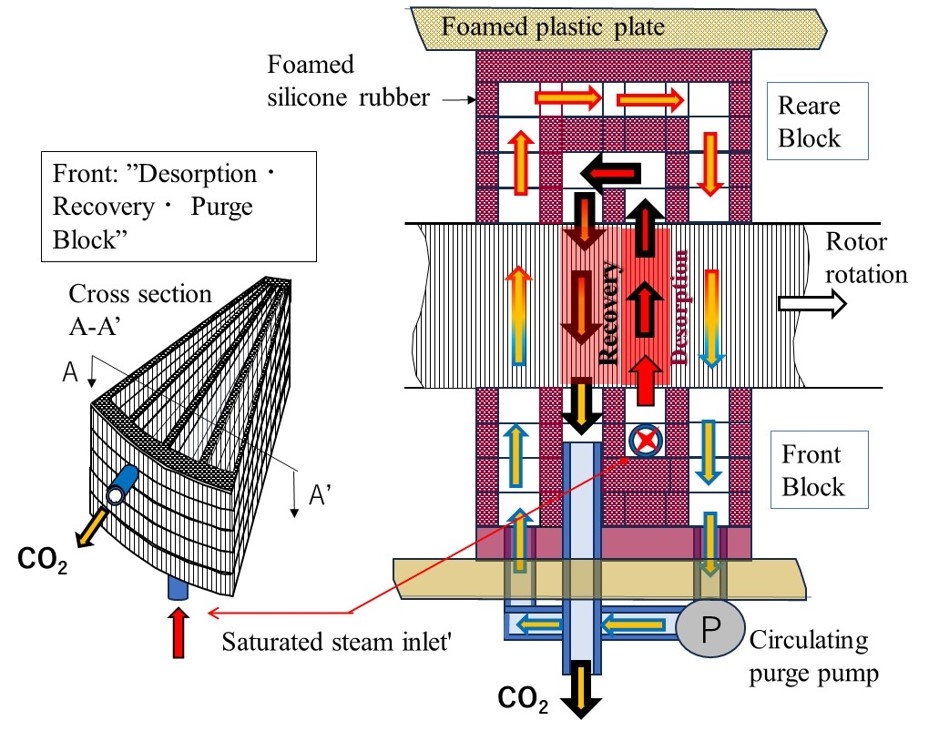
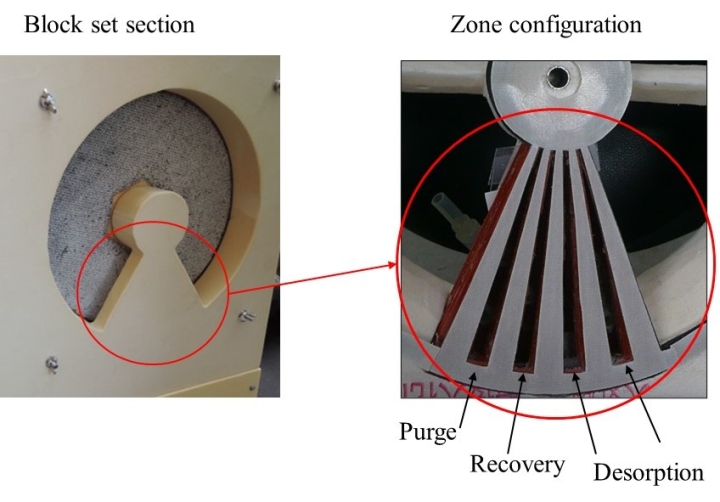
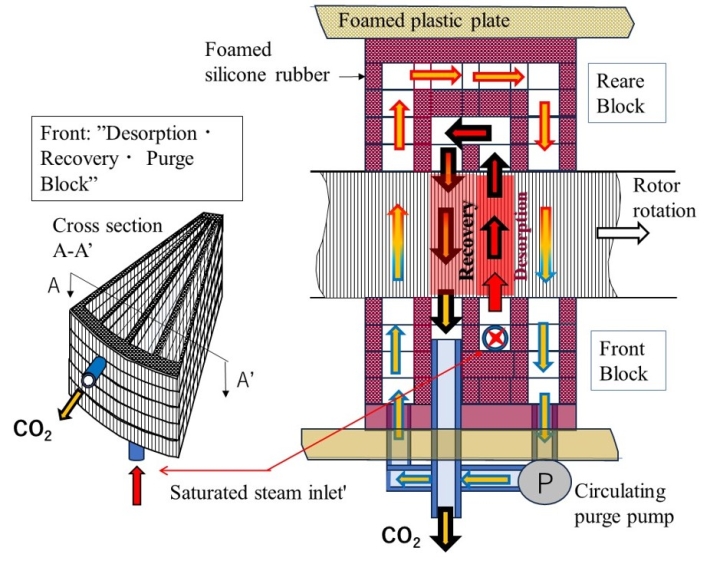
In a rotor-rotating system, as shown in the diagram, the rotor is divided into an absorption zone, a recovery zone, and a desorption zone in the direction of rotation, with the zones sealed together while the rotor rotates.
1. Air is passed through the absorption zone to sorb CO2.
2. When saturated steam at around 100°C is introduced into the desorption zone, the heat of condensation of the saturated steam desorbs the CO2 sorbed in the rotor.
3. The desorbed CO2 is recovered by passing through the recovery zone.
The secret advantage of this patented flow:
By passing the mixed gas of desorbed CO2 and steam through the recovery zone in the direction of rotation,
① As the rotor rotates, gases in the rotor voids and latent sorbed oxygen are expelled in the recovery zone, preventing oxygen from entering the desorption zone, which is the hottest zone, thus avoiding thermal oxidative degradation.
② The mixed gas at the outlet of the desorption zone still contains sufficient saturated vapor, so passing it through the recovery zone before the desorption zone preheats the rotor and recovers heat, resulting in energy savings.
③ The desorbed CO2 and vapor mixed gas is ultimately cooled and dehumidified to improve the purity of the CO2 gas, but this also has the effect of reducing cooling and dehumidification energy.
Circulation purge method
① A trick to further improve performance: Circulation purge method
After sorbing CO2 by passing processed air through the rotor, if the rotor is moved directly to the desorption zone to desorb the CO2, air present in the rotor's voids will mix into the desorption zone. This air mixing not only reduces the purity of the recovered gas, but also causes thermal oxidative degradation of the adsorbent, which is susceptible to thermal oxidation, due to contact with oxygen at high temperatures.
There are two circulating purge zones, one before and one after the desorption zone. Circulating purge replaces the air mixed in by the rotor's rotation with the desorbed CO2 gas, thereby improving the CO2 recovery concentration.
The Secret of the Innovative "Desorption Recovery Purge Block“
As mentioned above, the Wet-TSA concentration unit concentrates dilute CO2 at around 1000 ppm to nearly 100%, approximately 1000 times its original concentration. Furthermore, the "Desorption Recovery Purge Block" incorporates a design that improves energy efficiency through the recovery of CO2 and latent heat from saturated steam. Compared to conventional desiccant dehumidifiers and VOC recovery and concentration devices, it is uniquely designed to house an extremely compact and highly insulated "Desorption Recovery Purge Block" despite having a large number of densely packed zones and multiple complex bypass paths. Moreover, despite its complexity, the "Desorption Recovery Purge Block" can be manufactured very simply and easily, without requiring advanced technology, and with high insulation and low cost—a highly original feature not found in previous adsorption and concentration devices.
Multi-stage recovery zone for further improved energy efficiency
The basic principle of the patented flow is the single-stage recovery zone mentioned earlier, but the recovery zone can be made multi-stage to improve energy efficiency.
When separating, concentrating, and recovering CO2 from air, it is not necessary to make the sorption efficiency on the sorption side excessively high. This is because there is plenty of air, so it is sufficient to pass a large amount of air through a wide sorption zone, sorb only the amount that is easy to separate, and exhaust it. Even if the sorption rate decreases by narrowing the rotor width, reducing pressure loss and thus reducing blowing energy offers greater advantages in terms of initial cost, running cost, maintenance cost, and installation space reduction. For example, if the rotor width is 50 mm, the blowing energy will be one-eighth of that of a 400 mm wide rotor, but the CO2 adsorption rate is nearly 50%, so if the CO2 concentration of the passing air is 1000 ppm, the outlet CO2 concentration can be estimated to be around 500 ppm. At this concentration, the CO2 concentration is only slightly higher than that of the outside air, so it can be considered for reuse as air conditioning supply air.
On the other hand, narrowing the rotor width reduces the thermal efficiency of CO2 desorption energy. Even if the desorption zone outlet gas passes through the recovery zone once, the outlet gas is still a high-temperature, mixed gas containing a large amount of vapor, so a significant cooling and dehumidification load remains before the CO2 gas is compressed and liquefied.
Therefore, as shown in the diagram, by using a multi-stage recovery zone and passing the gas through multiple stages, even a 50 mm rotor can achieve the same desorption energy efficiency as a 150 mm wide rotor with three stages. While it doesn't triple the efficiency with three stages, it is close to 1.5 times that of a 50 mm wide rotor. In this way, the multi-stage recovery zone improves energy efficiency by reducing the cooling and dehumidification load before compression and liquefaction through preheating and heat recovery of the rotor using the CO2 and vapor mixed gas, and cooling and dehumidifying the recovery gas.
Why doesn't the Wet-TSA DAC increase CO2 recovery rate by increasing rotor depth?
◆ Increasing the recovery rate by increasing rotor depth exponentially increases the following disadvantages:
• Increased rotor depth → Larger size: To achieve an 80-90% recovery rate, the required thickness would increase approximately 8 times (e.g., 400mm).
• Regenerated steam volume would approximately double.
• Rotor pressure loss would increase 8 times. ➩ Power consumption of the air conditioning fan would increase approximately 8 times.
• Unit size would increase: From 200mm depth to over 600mm depth
➩ This would lead to the development of large-diameter rotor units similar to rotor dehumidifiers and VOC concentrators.
• Equipment cost: Sheet metal units would cost more than 10 times?
• Dedicated space required for equipment installation and maintenance would increase.
● By reducing the rotor depth (e.g., 50mm) and achieving a recovery rate of approximately 50% (which varies depending on the airflow velocity), an optimal DAC for urban environments can be realized as follows:
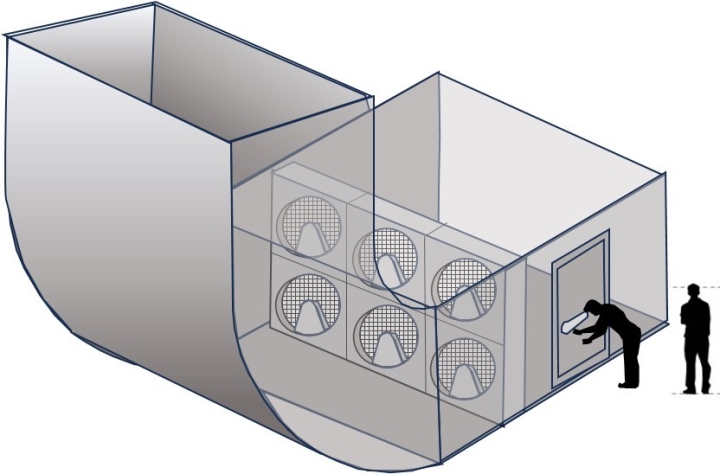
・ Due to its small size, even if a malfunction occurs, only the defective unit can be easily replaced with a good one manually. No crane is required.
・ Even if the rotor deteriorates due to acidic gases such as SOx and NOx, it can be replaced immediately.
・ Replaced units are refurbished at the factory and stored for future replacements.
・ Because the Wet-TSA unit offsets the heat of adsorption through "evaporative cooling of the wet rotor," it can operate with almost no increase in air conditioning load at a recovery rate of approximately 50%.
・ In urban buildings, "increased air conditioning load" is the most undesirable factor. Therefore, a CO2 recovery rate of around 50% is the optimal balance point between "the tolerance range of the air conditioning system" and "the amount of CO2 recovered."