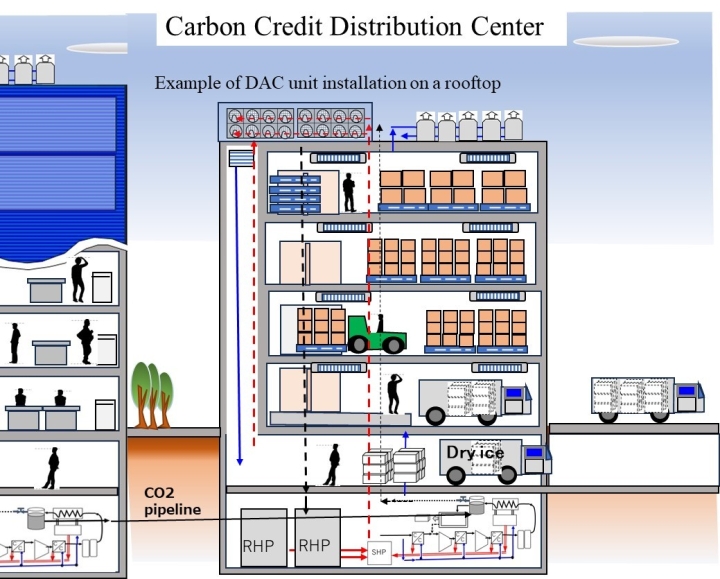
1.Green CO2 captured by urban Wet-TSA DACs has a higher value than gray CO2.
Carbon Credits for Wet-TSA DAC + CO2 Compression, Cooling, Liquefaction, and Dry Ice Production System
The carbon credit value of Wet TSA + Liquefied Waste Heat Reuse + Air Conditioning Exhaust DAC is significant.
Why "Energy Cost = Sales Cost" is Not True (Value is Higher)
✔ OKANO's system can be "Net Negative," therefore the product value exceeds the energy cost.
The reasons are as follows.
This is because it combines three values: "Emission Reduction Value (Carbon Credits)," "Product Value (Green CO₂/Green Dry Ice)," and "Urban Infrastructure Value (Recovery of Building Exhaust = CO₂ Derived from Human Respiration)."
Below, we will organize the value layers according to the structure of (Wet TSA + Liquefied Waste Heat Reuse + Air Conditioning Exhaust DAC). (Note: This information is generated by AI and should be used for reference only.)
2. Special characteristics of urban DACs: Recovery source is "CO₂ derived from human respiration" = not additional emissions
Normal DACs absorb "CO₂ from the atmosphere," so they are evaluated as: Recovery amount - Device emissions = Net reduction amount.
However, OKANO's method is different.
✔ Air conditioning exhaust = CO₂ derived from human respiration is an "unavoidable emission" in cities, and recovery is treated as a 100% reduction.
In other words:
• Humans breathe → CO₂ emission (unavoidable)
• Building air conditioning exhausts → CO₂ is released into the outside air
• Wet-TSA DAC device recovers it → This reduces unavoidable emissions in cities
This is treated as a "reduction of naturally occurring emissions," similar to forest absorption, so the recovered CO₂ can be counted directly as a reduction amount.
3. Strengths of Wet TSA + Liquefied Waste Heat Reuse: Extremely Low CO2 Emissions OKANO's system
• Reuses waste heat from compression and liquefaction as desorption energy
• Reuses residual air from liquefaction as DAC purge gas
• Utilizes the temperature and humidity of air conditioning exhaust (optimal temperature range for Wet-TSA)
This results in a larger amount of CO₂ recovered per unit of energy compared to conventional DAC.
In other words,
✔ Recovery amount ≫ Equipment emissions → Large net reduction → High carbon credit value
4. Price structure of carbon credits: Product value is "cost + reduction value"
Carbon credits are priced in the following ranges worldwide:
• EU-ETS (emissions allowance): €60-€90/t-CO₂
• VCM (Voluntary market): $20-$200/t-CO₂ (DAC is expensive)
• DAC credits (Frontier, etc.): $600-$1,000/t-CO₂
OKANO's urban DAC is highly likely to be classified as a "DAC credit".
In other words, the value of the product is:
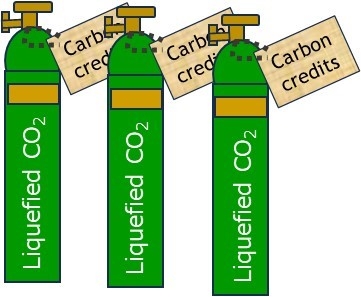
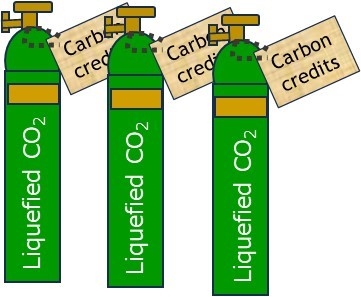
✔ Product value = Green CO₂ (liquefied/dry ice) + carbon credit value
What's important here is:
✔ Carbon credit value exists independently of "energy cost".
Even if the equipment emits some CO₂, if the recovery amount exceeds it, credits are generated as a "net reduction"
5. The value of OKANO's system can be expressed mathematically as follows: Value = Product Price (CO₂/Dry Ice) + Carbon Credit Value - Energy Cost Here,
Value = Product Price (CO₂/Dry Ice) + Carbon Credit Value - Energy Cost
Here,
• Product Price: Market price of liquefied CO₂ or dry ice
• Carbon Credit Value: Net reduction amount × Market price
• Energy Cost: CO₂ emissions from electricity and heat × Emission Factor In OKANO's method:
• Large net reduction amount
• Low energy cost due to waste heat reuse
• Urban DACs are easy to scale without requiring additional infrastructure
As a result,
✔ Value significantly exceeds energy cost.
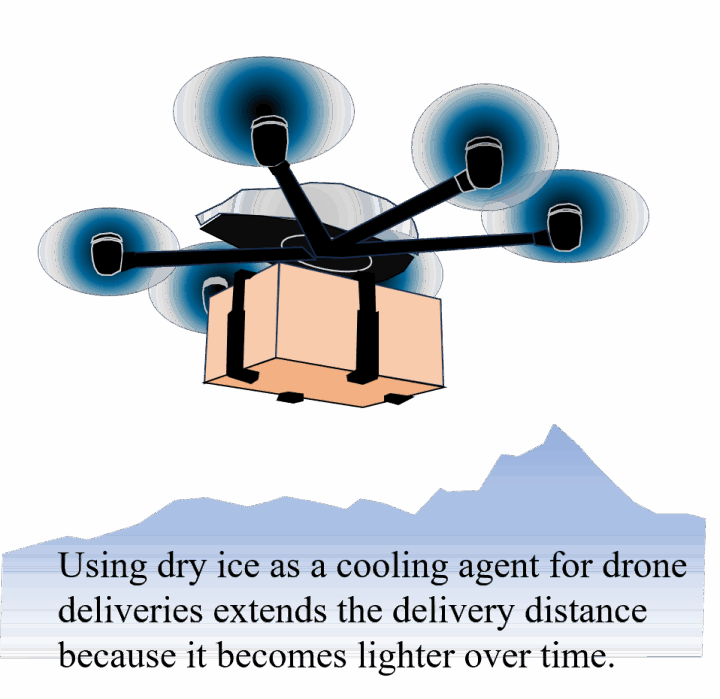
6. Additional Value in the Dry Ice Market: Logistics, Food, and Drone Delivery As OKANO pointed out, dry ice:
• Becomes lighter over time (increases transport efficiency)
• Does not produce waste
• Increased demand for frozen foods, pharmaceuticals, and drone delivery
• Can be produced near cities (reduces transport CO₂)
Here too, the reduction effect on LCA accumulates.
In other words,
✔ The product itself has value as a “low-carbon logistics infrastructure.”
7. Urban DAC + Liquefied CO₂ is Valued as “Urban Emission Reduction Infrastructure” OKANO's method is not merely product manufacturing,
✔ It is valued as an “urban carbon recycling infrastructure” that captures unavoidable urban emissions (breathing + air conditioning exhaust).
Conclusion: OKANO's system is not just about the "value of energy costs," but rather a high-value-added product.
Reasons summarized:
1. Human respiration-derived CO₂ is an unavoidable emission → Recovery results in a 100% reduction.
2. Wet TSA + waste heat reuse minimizes emissions → Net negative emissions.
3. DAC credits are in the high price range ($600-$1,000/ton).
4. Product value (liquefied CO₂/dry ice) + reduction value accumulate.
5. Value as urban infrastructure is added.
1~7 回収液化CO2及びドライアイスのカーボンクレジット評価
Wet‑TSA+液化排熱再利用+空調排気DACのカーボンクレジット価値は大きくなります。
「排出削減価値(カーボンクレジット)」「製品価値(グリーンCO₂・グリーンドライアイス)」「都市インフラ価値(ビル排気=人間呼吸由来CO₂の回収)」の三つが重なるからです。
以下、(Wet‑TSA+液化排熱再利用+空調排気DAC)の構造に合わせて、価値の層を整理します。 ((注)AIによる情報の為、参考情報としてください。)
1.都市型Wet-TSA DACで回収したグリーンCO2はグレーCO2より高い価値を持つ
✔ OKANOのシステムは「ネット負排出(Net‑Negative)」になり得るため、製品価値はエネルギー原価を超える。
理由は以下の通り。
2. 都市型DACの特殊性:回収源が「人間呼吸由来CO₂」=追加排出ではない
通常のDACは「大気中のCO₂」を吸うため、 回収量 − 装置の排出量 = ネット削減量 で評価されます。
しかしOKANOの方式は違う。
✔ 空調排気=人間呼吸由来CO₂は、都市の“不可避排出”であり、回収すれば100%削減扱いになる。
つまり:
- 人間が呼吸する → CO₂排出(不可避)
- ビル空調が排気する → CO₂が外気へ放出される
- Wet-TSA DAC装置が回収する → 都市の不可避排出を削減したことになる
これは森林吸収と同じ「自然由来排出の削減」として扱われるため、 回収したCO₂はそのまま削減量としてカウントできる。
3. Wet‑TSA+液化排熱再利用の強み:CO2排出量が極端に小さい
OKANOのシステムは:
- 圧縮・液化時の排熱を脱着エネルギーに再利用
- 液化時の残留空気をDACのパージガスに再利用
- 空調排気の温湿度を利用できる(Wet-TSAの適温域)
これにより、通常のDACより エネルギー当たりの回収CO₂量が大きい。
つまり、
✔ 回収量 ≫ 装置排出量 → ネット削減量が大きい → カーボンクレジット価値が高い
4. カーボンクレジットの価格構造:製品価値は“原価+削減価値”
カーボンクレジットは世界で以下の価格帯:
- EU-ETS(排出権):€60〜€90/t-CO₂
- VCM(ボランタリー市場):$20〜$200/t-CO₂(DACは高値)
- DACクレジット(Frontier等):$600〜$1,000/t-CO₂
OKANOの都市型DACは「DACクレジット」に分類される可能性が高い。
つまり、製品の価値は:
✔ 製品価値 = グリーンCO₂(液化・ドライアイス)+ カーボンクレジット価値
ここで重要なのは:
✔ カーボンクレジット価値は“エネルギー原価”とは独立して存在する。
たとえ装置が多少のCO₂を排出しても、 回収量がそれを上回れば“ネット削減”としてクレジットが発生する。
5. OKANOのシステムの価値を数式で表すとこうなる
価値=製品価格(CO₂/ドライアイス)+カーボンクレジット価値−エネルギー原価
ここで、
- 製品価格:液化CO₂やドライアイスの市場価格
- カーボンクレジット価値:ネット削減量 × 市場価格
- エネルギー原価:電力・熱のCO₂排出量 × 排出係数
OKANOの方式では:
- ネット削減量が大きい
- 排熱再利用でエネルギー原価が小さい
- 都市型DACは追加インフラ不要でスケールしやすい
結果として、
✔ 価値はエネルギー原価を大きく上回る。
6. ドライアイス市場での追加価値:物流・食品・ドローン配送
OKANOが指摘した通り、ドライアイスは:
- 時間とともに軽くなる(輸送効率が上がる)
- ゴミにならない
- 冷凍食品・医薬品・ドローン配送で需要増加
- 都市近接で生産できる(輸送CO₂が減る)
ここでも LCA上の削減効果が追加で積み上がる。
つまり、
✔ 製品そのものが“低炭素物流インフラ”として価値を持つ。
7. 都市型DAC+液化CO₂は「都市の排出削減インフラ」として評価される
OKANOの方式は単なる製品製造ではなく、
✔ 都市の不可避排出(呼吸+空調排気)を回収する“都市炭素循環インフラ”
として評価される。
結論:OKANOのシステムは“エネルギー原価だけの価値”ではなく、むしろ高付加価値商品になる
理由をまとめると:
- 人間呼吸由来CO₂は不可避排出 → 回収すれば100%削減扱い
- Wet‑TSA+排熱再利用で排出量が極小 → ネット負排出
- DACクレジットは高価格帯($600〜$1,000/t)
- 製品価値(液化CO₂・ドライアイス)+削減価値が積み上がる
- 都市インフラとしての価値が追加される